Guide
How to Clean Freezer Coils on a Sub-Zero Built-In
To clean freezer coils, switch the appliance off, locate the condenser coil (on a Sub-Zero built-in it sits behind the top grille or the lower kickplate, never on the back), and vacuum away the dust with a soft brush attachment, stroking in the same direction as the fins. Repeat that every six to twelve months and the compressor spends less of its day running just to hold temperature. On Coronado, where no home is far from the bay or the Pacific, the chore matters more than it does inland, because airborne salt and fine sand settle into the same fins that kitchen dust and pet hair already clog.
Which coils need cleaning, and which to leave alone
Every freezer has two sets of coils doing opposite jobs. The evaporator lives inside the cabinet, usually behind a rear panel, and it is the cold one that pulls heat out of the air around your food. The condenser lives outside the cold space and sheds that heat into the room. When people search for how to clean freezer coils, the condenser is the part they mean, and it is the only one a homeowner should touch. The evaporator stays sealed behind its cover, and in a frost-free freezer an automatic defrost cycle keeps it clear on its own schedule. A thick white sheet of frost spreading across the back wall of the freezer is a sign of a defrost or airflow fault, not something a brush can fix. Some chest freezers and older garage models show no condenser at all, because the tubing runs inside the outer walls; those simply need a few inches of open space around the cabinet so the walls can release heat.
- Condenser: outside the cold zone, gathers dust, safe for the owner to vacuum
- Evaporator: inside the cabinet behind a panel, left to the defrost system or a technician
- Wall-mounted tubing in some chest freezers: nothing to clean, just keep the sides clear
Where the condenser hides on a Sub-Zero
A built-in sits flush against the wall and the cabinetry, so Sub-Zero does not put the coil on the back where nobody could reach it. On Classic (CL) models the condenser is up top, behind a grille that flips up. On Designer models, labeled DET or DEC, it is down low behind the kickplate, which comes off once you remove two screws. Undercounter and outdoor units also breathe through the front, so the logic holds: the vented panel at toe level or above the doors is the air intake, and the coil sits just behind it. If you are unsure which series you own, the rating tag inside the compartment lists the model, and the use and care guide for that series shows the exact panel to open. Owners with a patio or bar unit can find more about those models on our outdoor undercounter page.
The cleaning routine, start to finish
The job is short, but it goes best with the right few items laid out first: a vacuum with a soft brush attachment, a flashlight, a pair of work gloves and a screwdriver if your model has a kickplate. Sub-Zero asks owners to turn the unit off at its own control panel before starting, and on a freestanding freezer pulling the plug does the same thing. The fins are thin aluminum and fold over at the slightest pressure, which is why gloves protect your hands from their edges and light strokes protect the coil from you.
- Turn the unit off at the control panel, or unplug a freestanding freezer
- Flip up the top grille on a CL, or back out the two kickplate screws on a DET or DEC
- Pull on gloves and aim the flashlight into the coil so you can see where the lint has packed in
- Vacuum with the soft brush, moving along the fins rather than across them
- Wipe the grille or kickplate itself, since a furred-over vent starves a clean coil of air
- Put the panel back, switch the unit on and give it several hours to settle before judging the temperature
How often, and why an island kitchen collects more
Sub-Zero sets the interval at every six to twelve months, shortened in a house with pets. The USDA, writing about food safety, makes a parallel point for refrigerators in general: lint and dust caked on the front grill starve the condenser of air, and the coil itself deserves a pass with a brush or vacuum several times each year. A new unit gets a pass, since Sub-Zero says one less than 6 months old does not yet need its condenser cleaned. On Coronado it pays to stay near the short end of that range. Sand rides home on sandals and beach towels, the onshore breeze carries salt, and a grille at floor level is the first thing that air meets inside the kitchen. For homes in Coronado Cays or the oceanfront towers of The Shores, salt is a corrosion concern as much as a dust one, which our guide on salt air and the condenser covers in depth. An easy reminder is to peek at the grille every time the clocks change in spring and fall.
- Every six to twelve months as the baseline
- Every few months with a shedding dog or cat in the house
- More often for a patio unit that faces sea air, sand and pool deck traffic
Mistakes that turn a cleaning into a repair
Most harm done during coil cleaning comes from trying too hard. Sub-Zero says chemical condenser cleaners are not necessary and advises against them, and a can of compressed air fired at close range can flatten fins and drive lint deeper into the coil rather than out of it. Keep wire brushes, screwdriver tips and garden hoses away from the fins, and keep every liquid away from the wiring and controls mounted beside the condenser. Inside the freezer, resist the urge to chip at built-up ice. The USDA warns that an ice pick, a knife, any other sharp object or an electrical heating device used to speed a manual defrost can damage the inner lining, and a gouged liner or a punctured tube hidden behind it turns a free chore into a major repair.
- No chemical coil sprays or foams
- No wire brushes, blades or water on the fins
- No ice picks, knives or heaters to remove frost
- No cleaning while the compressor is running
When a clean coil is not the answer
Cleaning is often the right first move but not always the last one. Some Sub-Zero panels flash a Vacuum Condenser message when the unit is running inefficiently or temperatures have climbed too high, and the cause can be a dusty coil, a door that is not sealing or a fault in the unit itself; Sub-Zero's advice is to clean the condenser and then turn the unit back on, which resets the message. On certain control panels the word Service blinks between the zone temperatures instead, a warning Sub-Zero ties to the compressor running far more than it should. If the temperatures are still close to normal, clean the condenser and flip the home's breaker off for 30 seconds before restoring power. If either warning returns, or the refrigerator reads above 48 degrees while it is set at 38, Sub-Zero says a condenser cleaning is unlikely to bring it back, and that is the moment to call for service. The same applies to the split symptoms owners describe, where the freezer works but the refrigerator side runs warm, or the refrigerator is fine but the freezer is not cold enough; those tend to trace back to a fan, an air damper, the defrost system or the sealed system rather than to dust.
- Vacuum Condenser flashing: clean the coil, then turn the unit back on
- Service flashing with near-normal temperatures: clean the coil, then kill the breaker for 30 seconds
- Above 48 degrees with the dial at 38: book a technician rather than cleaning again
What a professional tune-up adds
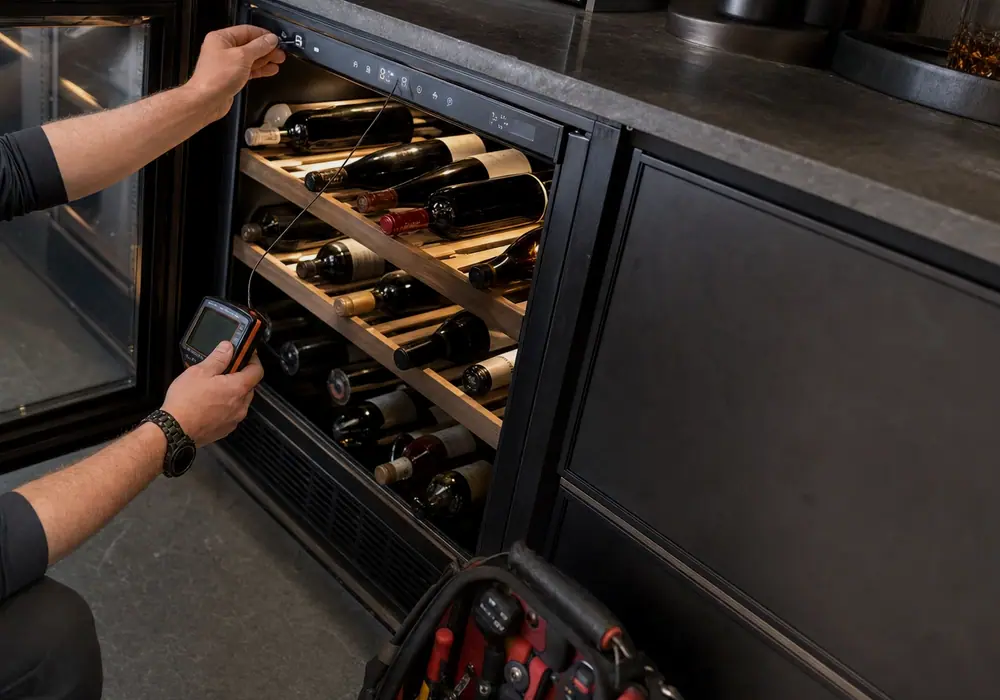
A technician reaches what a vacuum cannot. On a freezer visit that means checking that the condenser and evaporator fans spin freely, confirming the defrost system is actually clearing the evaporator, measuring real temperatures in each zone against the settings, and running a hand and an eye along the full length of every door seal. Seals deserve that attention as much as coils do: ENERGY STAR recommends keeping refrigerator door gaskets airtight and replacing any that leak, and Sub-Zero recommends that a service technician handle door or drawer gasket replacement, with those gaskets sold only through its parts distributors rather than online. Between visits, wipe the gasket with mild detergent and water on a soft cloth, and skip vinegar and rubbing alcohol, which Sub-Zero says to avoid. Ours is an independent service that is not affiliated with Sub-Zero, taking calls from Coronado Village, The Shores, Coronado Cays and the rest of Coronado. If your freezer still struggles after a careful cleaning, our freezer repair page explains what we check and how a visit works.
Questions
Frequently asked questions
How often should I clean my freezer coils?
Plan on a cleaning every six to twelve months, which is the schedule Sub-Zero sets for its own condensers, and shorten it if a dog or cat sheds indoors. A unit under 6 months old does not need it yet. Kitchens that see a lot of beach sand and sea breeze tend to load the grille faster, so check it whenever the seasons turn. Coronado Island Sub-Zero Repair, Coronado: (858) 375-1585.
Can I use a coil cleaner spray on freezer coils?
No, a vacuum with a soft brush is all the condenser needs. Sub-Zero says chemical condenser cleaners are unnecessary and not recommended, and a stiff tool or a hard blast of spray can fold the thin aluminum fins, which chokes off the very airflow you were trying to restore. Say so when you call Coronado Island Sub-Zero Repair on (858) 375-1585.
Why is my freezer still not cold after I cleaned the coils?
A clean condenser only helps when dust was the cause, so warmth that lingers points elsewhere, such as a weak fan, a defrost fault, a leaking door seal or a sealed-system problem. If the fresh-food side reads above 48 degrees while set at 38, Sub-Zero says cleaning is unlikely to fix it and a technician should take a look. Coronado Island Sub-Zero Repair answers that on (858) 375-1585.
Appliance down in Coronado?
Tell us the brand and what it is doing — we can usually name the likely repair before we arrive.