Guide
Can You Vacuum Sub-Zero Refrigerator Coils? A Safe Routine
Yes, you can vacuum refrigerator coils, and for most homes it is the best way to clean them. Shut the power off first, fit the soft round dusting brush to your vacuum hose, and draw it slowly along the direction the thin metal fins run, never across them. Sub-Zero asks owners to do this every six to twelve months, more often where a dog or cat sheds, and it says chemical coil cleaners are neither needed nor recommended. On Coronado the habit earns its keep, because the island sits between San Diego Bay and the Pacific, and fine sand rides home on shoes, towels and paws before settling low in the kitchen, right where many condensers draw in their air.
Where the coils are on your refrigerator
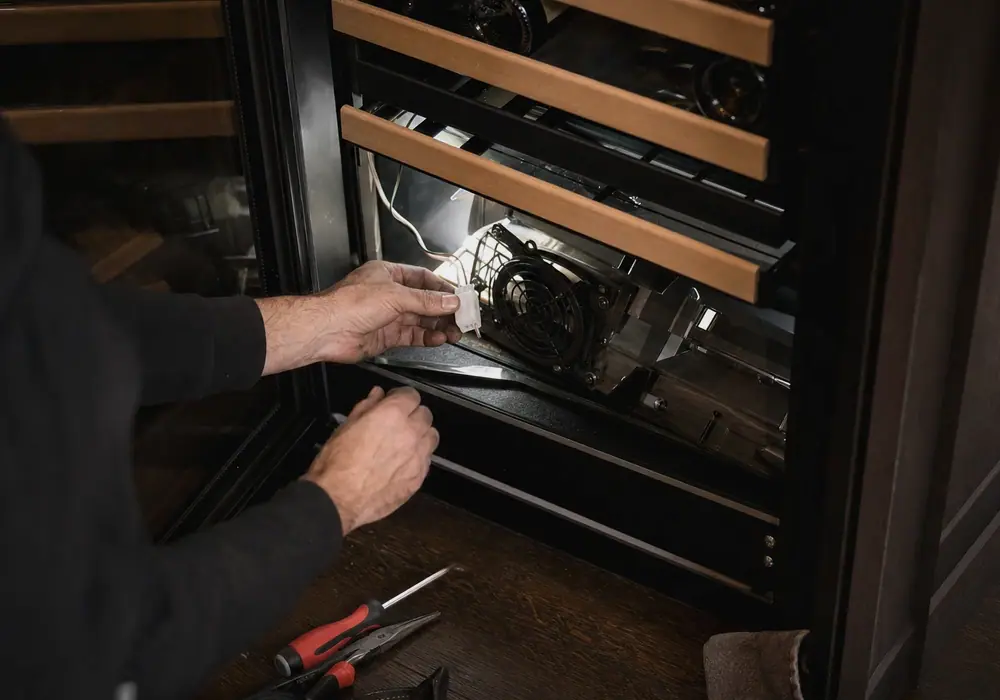
Before the vacuum comes out, find the condenser, because its position depends on how the refrigerator was built. An older freestanding model may carry a black grid of tubing across its back, a static coil cooled by nothing more than room air rising past it. Most newer freestanding refrigerators hide a compact, fan-cooled coil underneath, reached through a snap-off grille at floor level or a panel at the rear. Sub-Zero built-ins are designed so the condenser can be reached from the front, which spares you from dragging a heavy cabinet out of its opening.
- Classic (CL) built-ins: behind the grille above the doors, which flips up.
- Designer (DET, DEC) units: behind the kickplate at floor level, held in place by two screws.
- Undercounter, wine and ice units: through the lower front grille, since a unit tucked under a counter has no room behind it for air to move.
The different types of refrigerator coils
Every refrigerator has two kinds of coil, and only one of them should ever meet your vacuum. The evaporator is the cold coil inside the cabinet, normally hidden behind a panel in the freezer section, where it pulls heat out of the air that circulates around your food. The condenser is the warm coil outside the insulated box, where the compressor dumps that collected heat into the room. Condensers come in two broad styles: a static coil spread wide so air can drift past it on its own, and a tight, finned coil packed into a small space with a fan pulling air through. The finned style does more work in less room, but its narrow gaps trap lint, pet hair and grit far faster. Frost on the evaporator is a different matter: the USDA warns against chipping at it with a knife or ice pick or warming it with an electric heater, and our guide on how to clean freezer coils covers that side of the job.
How to vacuum the condenser without harming it
Vacuuming a condenser is a short job once you can see it, and the real hazard is pressing too hard. The aluminum fins are thin, and once a patch folds flat, air stops passing through that part of the coil, so a spotless coil with crushed fins can run hotter than a slightly dusty one.
- Turn the unit off. On a Sub-Zero, use the power control on the control panel; on other refrigerators, unplug it or switch off the breaker.
- Put on work gloves, because the fin edges are sharp enough to cut a knuckle.
- Remove the grille or kickplate and keep the screws in a cup so none roll under the cabinet.
- Hold the soft brush just touching the coil and move it with the fins, letting suction carry the dust away.
- Reach deeper pockets with a long, flexible coil brush, then vacuum up whatever it loosens.
- Keep water and chemical sprays away from the coil; liquid turns dust into a paste that clogs the gaps.
- Vacuum the grille and the floor under it, refit everything, and restore power.
How often to do it, and when you can skip it
Sub-Zero's schedule is every six to twelve months, at the shorter end in homes with pets, and it adds that a unit less than six months old does not need its condenser cleaned yet. The USDA's food safety guidance takes a broader view for refrigerators of any make: keep the front grill clear of dust and lint so air can reach the condenser, and clean the coil several times a year with a brush or a vacuum. The Shores sits right on the beach and much of Coronado Village is a short walk from the sand, so treating twice a year as the minimum makes sense here, and homes in Coronado Cays that face the water carry an extra concern covered in our guide to salt air and the condenser.
Choosing a coil brush and a vacuum
There is no single best refrigerator coil tool, but a few traits separate a helpful one from a harmful one. A coil brush should be long, slim and flexible, with soft bristles that bend into the gaps instead of stiff ones that rake the fins sideways. For the vacuum, a gentle, steady pull and a soft dusting head count for more than raw power, and a handheld or a canister with a hose reaches a kickplate opening far more easily than an upright does. Keep the hard plastic tip of a crevice tool off the coil, and use a flashlight to check the far side before you close up.
When a clean coil is not the answer
Cleaning helps a refrigerator that is straining, but it cannot rescue one that has stopped cooling properly. Sub-Zero draws the line plainly: when the fresh-food side is dialed to 38 yet the thermometer shows more than 48 degrees, clearing the coil will probably not restore it, so book service instead. People who search for a replacement coil should know the condenser belongs to the sealed refrigerant system, so swapping one means recovering refrigerant and brazing new joints, which is work for Sub-Zero refrigerator repair rather than a weekend project. The control panel will often tell you which situation you are in.
- Vacuum Condenser flashing: the unit is running inefficiently or too warm, from a dirty coil, a door that is not sealing or a fault in the unit; clean the condenser, then switch the unit back on to reset the message.
- EC50 with Service flashing: the compressor is logging far too much run time; when the cabinet is close to its usual temperature, vacuum the coil and keep a finger on the bell button that silences the open-door alert for 15 seconds, and when the cabinet is warm, skip the reset and call.
- A condenser fan that will not spin, an oily stain on the tubing, or a large area of crushed fins all call for a technician.
A yearly routine that keeps the coil doing its job
The coil cleaning pays off best as part of a short routine you repeat on the calendar. ENERGY STAR advises keeping door seals airtight, keeping the door closed as much as you can and, especially on older models, keeping the condenser clean, because each of those cuts the hours the compressor runs. On a Sub-Zero, check the gaskets while the kickplate or grille is off, wiping them with mild soap and water on a soft cloth and avoiding vinegar and rubbing alcohol. A technician's visit can add what a vacuum cannot, such as a look at the condenser fan, the defrost system and the temperatures the unit holds under load.
- Every six to twelve months: vacuum the condenser and wipe the grille.
- Every 12 months or 750 gallons: replace the water filter on Classic (CL) and Designer (DET, DEC) models.
- About once a year: change the air purification cartridge, part 7042798, on units that have one.
- Any time: keep the front grille free of rugs, bins or anything else that blocks the airflow.
Questions
Frequently asked questions
How do you clean coils on a fridge?
Switch the power off, open the grille, kickplate or rear panel that hides the condenser, and lift the dust away with a vacuum and a soft brush, working in the direction the fins run. Wear gloves, leave spray cleaners in the cupboard, wipe the grille, then restore power and listen for the fan and compressor to start. Say so when you call Coronado Island Sub-Zero Repair on (858) 375-1585.
What is a refrigeration coil?
A refrigeration coil is a length of tubing, usually threaded through thin metal fins, that moves heat into or out of the refrigerant. The evaporator coil inside the cabinet soaks up warmth from the food space, and the condenser coil outside the cold zone releases that warmth into your kitchen. Coronado Island Sub-Zero Repair answers that on (858) 375-1585.
What should freezer coils look like?
A healthy freezer coil shows bare metal or a light, even film of frost, depending on where the unit sits in its defrost cycle; on a frost-free model it hides behind the rear panel. Thick ice, frost covering only part of the coil, or frost creeping onto the panel itself suggests a defrost or airflow fault worth having checked. Call Coronado Island Sub-Zero Repair on (858) 375-1585 and ask.
Appliance down in Coronado?
Tell us the brand and what it is doing — we can usually name the likely repair before we arrive.